In the context of the ongoing digital transformation across all sectors of socio-economic life, e-commerce is not only a development trend for businesses but also one of the key solutions to promote rural economic development.
According to Decision No. 51/2025/QD-TTg of the Prime Minister promulgating the National Criteria Set for New Rural Development in the period 2026–2030, along with the provisions of the 2025 E-commerce Law, Criterion 7.3 is developed to assess the level of e-commerce development at the commune level, aiming to form a synchronized digital ecosystem that helps local people, cooperatives, and businesses expand their markets, enhance product value, and increase sustainable income.
Unlike the previous approach which focused solely on listing products on e-commerce platforms, Criterion 7.3 places emphasis on the actual effectiveness of e-commerce activities. A commune is assessed as having effectively implemented e-commerce when it has built the infrastructure, ecosystem, and conditions for businesses to proficiently apply digital skills, conduct business directly in the online environment, and effectively utilize logistics services, traceability, and digital payment.
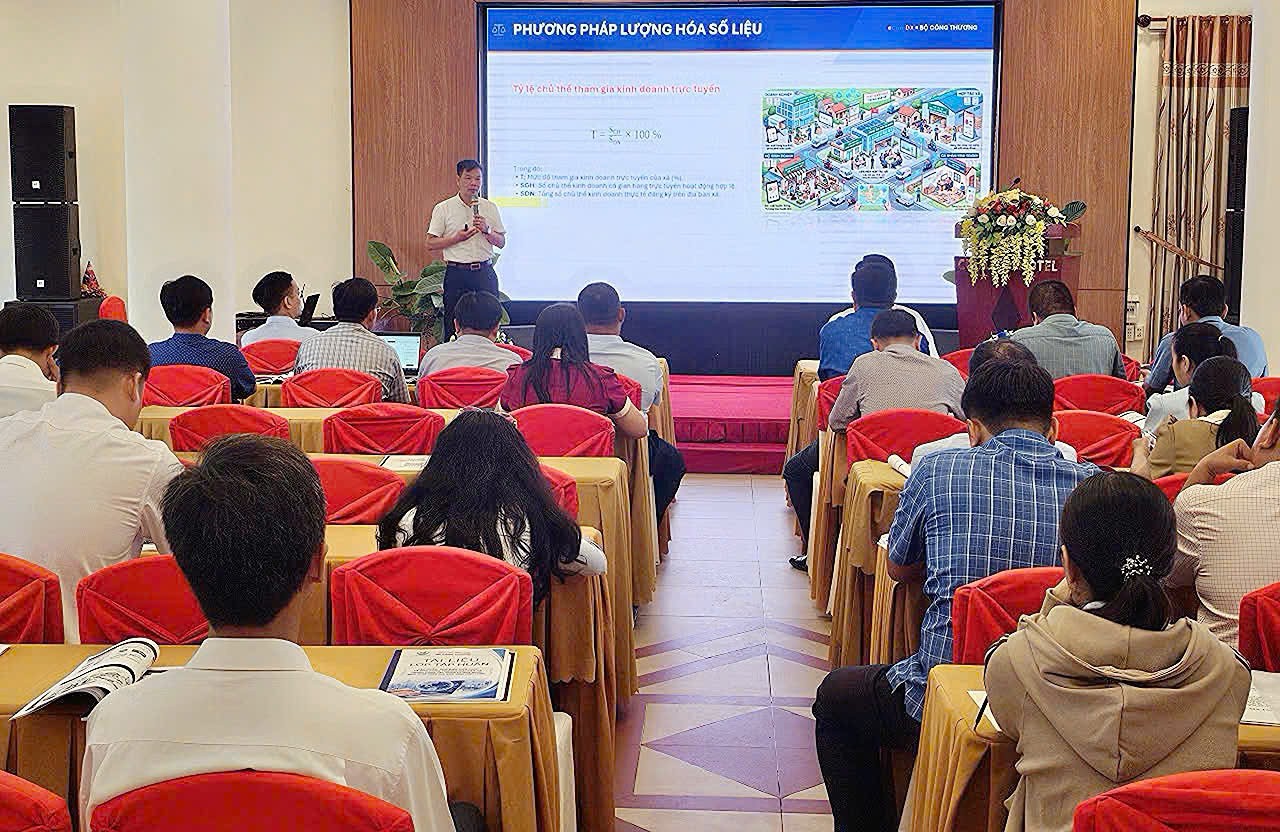
Mr. Nguyen Huu Tuan - Director of eComDX, shared his insights at the training conference in Vinh Long.
On March 31, 2026, the Ministry of Industry and Trade issued Circular No. 17/2026/TT-BCT (Circular 17) to concretize the regulations and guidelines for implementing Criterion 7.3 "Effective implementation of e-commerce activities" under the National Criteria Set for New Rural Communes in the 2026-2030 period.
Mr. Nguyen Huu Tuan, Director of eComDX, stated that the implementation of Circular 17 is of significant importance in making e-commerce a tool to support rural economic development, helping people and businesses access a wider market, enhancing the value of local products, and creating a foundation for localities to build new rural communes in a modern, sustainable direction linked to the development of the digital economy, improving the competitiveness of businesses, cooperatives, households, and OCOP entities, thereby contributing to promoting digital transformation and expanding product consumption markets.
According to Mr. Tuan, there are three important pillars that constitute Criterion 7.3.
Firstly, digital skills and capabilities are crucial. This is considered the foundation for the success of e-commerce at the local level. Businesses need practical training in livestreaming sales, digital marketing, online advertising, and the application of artificial intelligence (AI) in business and cross-border e-commerce. Simultaneously, government officials need training in management, inspection, consumer protection, and combating counterfeit goods in the digital environment. Citizens should also be taught how to use smartphones to check prices, search for products, and how to avoid online scams.
Secondly, it's crucial to build a community-based e-commerce ecosystem . Each locality should establish community support groups with the participation of the Youth Union, the Women's Union, and other organizations to assist residents in opening online stores, taking product photos, creating promotional content, and providing guidance on selling on digital platforms. In addition, localities should develop support groups on Zalo and Facebook; identify exemplary business entities to act as "leaders"; coordinate with postal and logistics companies to implement door-to-door delivery services; and organize livestream sessions to promote local specialties, spearheaded by the government.
Thirdly, the assessment will evaluate the level of e-commerce implementation through specific indicators such as the percentage of businesses participating in online sales; the percentage of OCOP products with 3 stars or more and typical rural industrial products that have been digitized and uploaded to digital platforms; the percentage of products applying QR codes for traceability; as well as the total e-commerce revenue of businesses in the area.
Mr. Tuan stated that the highlight of the Guidelines is the quantification of criteria using specific indicators, making it easier for localities to monitor, evaluate, and develop implementation plans. At the same time, the document also provides detailed guidance on methods for data collection, surveys, statistics, building supporting documentation, and the appraisal process, creating uniformity in the evaluation process nationwide.
To support communes and wards in effectively implementing the National Criteria for New Rural Communes in the 2026-2030 period, the Department of Industry and Trade of Vinh Long province recently collaborated with the Center for E-commerce and Digital Technology Development (eComDX), the Department of E-commerce and Digital Economy - Ministry of Industry and Trade, to organize a training program to disseminate guidance on implementing Criterion 7.3 on "Effective implementation of e-commerce activities".
The Director of eComDX believes that for localities with many specialty agricultural products, OCOP products, and traditional craft villages like Vinh Long province, effectively implementing Criterion 7.3 will contribute to expanding the consumer market, increasing the value of agricultural products, reducing dependence on traditional sales methods, and increasing accessibility to consumers nationwide. At the same time, according to Mr. Tuan, this is also an opportunity for local cooperatives, business households, and enterprises to promote the application of digital technology, enhance competitiveness, and gradually participate in the digital value chain.
Leaders of the Department of Industry and Trade of Vinh Long province assessed that, with the close cooperation of the Center for E-commerce and Digital Technology Development (eComDX), the training course content was designed to be practical and relevant, helping state management officials, political and social organizations, cooperatives, businesses, and business households in the province to fully update new regulations, evaluation methods, and solutions for implementing Criterion 7.3 in a systematic, effective, and appropriate manner to the local conditions.
Mr. Nguyen Huu Tuan emphasized that, with the support of eComDX and the determination of local authorities, the implementation of Criterion 7.3 is expected to create a strong shift in the development of e-commerce in rural areas, contributing to promoting the digital economy, building modern new rural areas, and improving the income and quality of life of people in the new era.