On August 27, 2026, in Dien Bien, the Department of Industry and Trade, in coordination with the Center for E-commerce and Digital Technology Development - eComDX (Department of E-commerce and Digital Economy, Ministry of Industry and Trade), organized a training conference on e-commerce with the theme "Digital Business and Online Market Development for Enterprises".
.jpeg)
Overview of the Conference
The conference was attended by Mr. Luong Tuan Anh - Deputy Director of the Department of Industry and Trade of Dien Bien province, Mr. Nguyen Huu Tuan - Director of eComDX, and state management officials, businesses, business households, and cooperatives in Dien Bien province.
E-commerce helps expand the market for local products.
In his opening remarks at the conference, Mr. Luong Tuan Anh, Deputy Director of the Department of Industry and Trade of Dien Bien province, stated that in recent years, e-commerce has become an increasingly popular business method, playing a crucial role in connecting supply and demand, promoting products, expanding markets, and enhancing the competitiveness of businesses. For a mountainous, border province like Dien Bien, e-commerce and digital platforms open up many opportunities for businesses, cooperatives, households, OCOP (One Commune One Product) entities, and individuals to overcome geographical limitations, bringing the province's distinctive products, agricultural products, and OCOP products to a wider range of customers, gradually expanding markets both within and outside the province.

Mr. Luong Tuan Anh - Deputy Director of the Department of Industry and Trade of Dien Bien Province
However, to effectively capitalize on the opportunities offered by e-commerce, according to the Head of the Department of Industry and Trade, besides technological infrastructure, one of the crucial factors is human resources with the knowledge, skills, and ability to apply digital platforms and tools to practical management, production, and business. Therefore, the Dien Bien Provincial Department of Industry and Trade, in coordination with the Center for E-commerce and Digital Technology Development, organized a training course on e-commerce with the theme "Digital Business and Online Market Development for Enterprises".
Speaking at a conference on the key contents of the E-commerce Law No. 122/2025/QH15 (E-commerce Law 2025) and Decree No. 248/2026/ND-CP, Mr. Nguyen Huu Tuan - Director of eComDX - helped managers, businesses, and business entities in Dien Bien province better identify the new requirements when participating in the digital market. Mr. Tuan emphasized that the new law not only sets stricter management requirements but also aims at "Compliance to unlock resources and create a fair and favorable business environment."
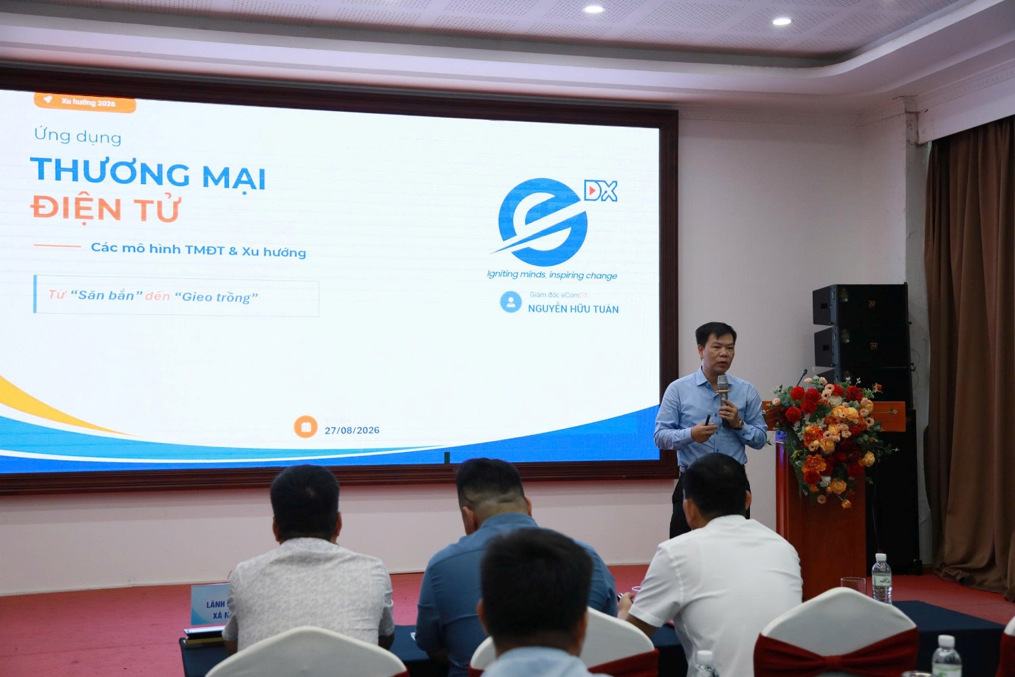
Mr. Nguyen Huu Tuan - Director of eComDX, shared at the Conference.
For localities with unique characteristics like Dien Bien province, the Director of eComDX noted the need to focus on "specific support policies for e-commerce development" for household businesses, startups, cooperatives, businesses owned by women, ethnic minorities, and mountainous, border, and island areas. Mr. Tuan suggested several policies such as: supporting digital infrastructure, establishing online stores on platforms, training e-commerce business skills, supporting administrative procedures, and building model e-commerce sites in ethnic minority and mountainous areas. These are practical measures for Dien Bien in making e-commerce a tool for expanding markets for local products.
Criterion 7.3 provides a basis for planning e-commerce development solutions suitable for each locality.
One of the issues of particular interest to localities currently is understanding the content of Criterion 7.3 on the effective implementation of e-commerce activities in the construction of new rural areas in the period 2026-2030.
Therefore, at the training conference, Mr. Tuan focused on guiding localities from "understanding the criteria" to knowing how to organize implementation, collect data, and complete supporting documents, in accordance with the actual conditions in Dien Bien.
Accordingly, Mr. Tuan helped the trainees understand the three main pillars that constitute the criteria for evaluating "Effective E-commerce Implementation in Communes." The first pillar is "Digital Capacity and Skills," focusing on the ability of local entities to participate in and operate e-commerce activities. The second pillar is "Local Community Ecosystem," emphasizing the role of support networks and the participation of local forces. The third pillar is "Level of Implementation," reflecting the actual results of e-commerce development in each locality. Mr. Tuan stressed that specific indicators and evaluation thresholds will be analyzed so that localities can compare them with the actual situation, identify strengths, gaps, and areas for improvement.
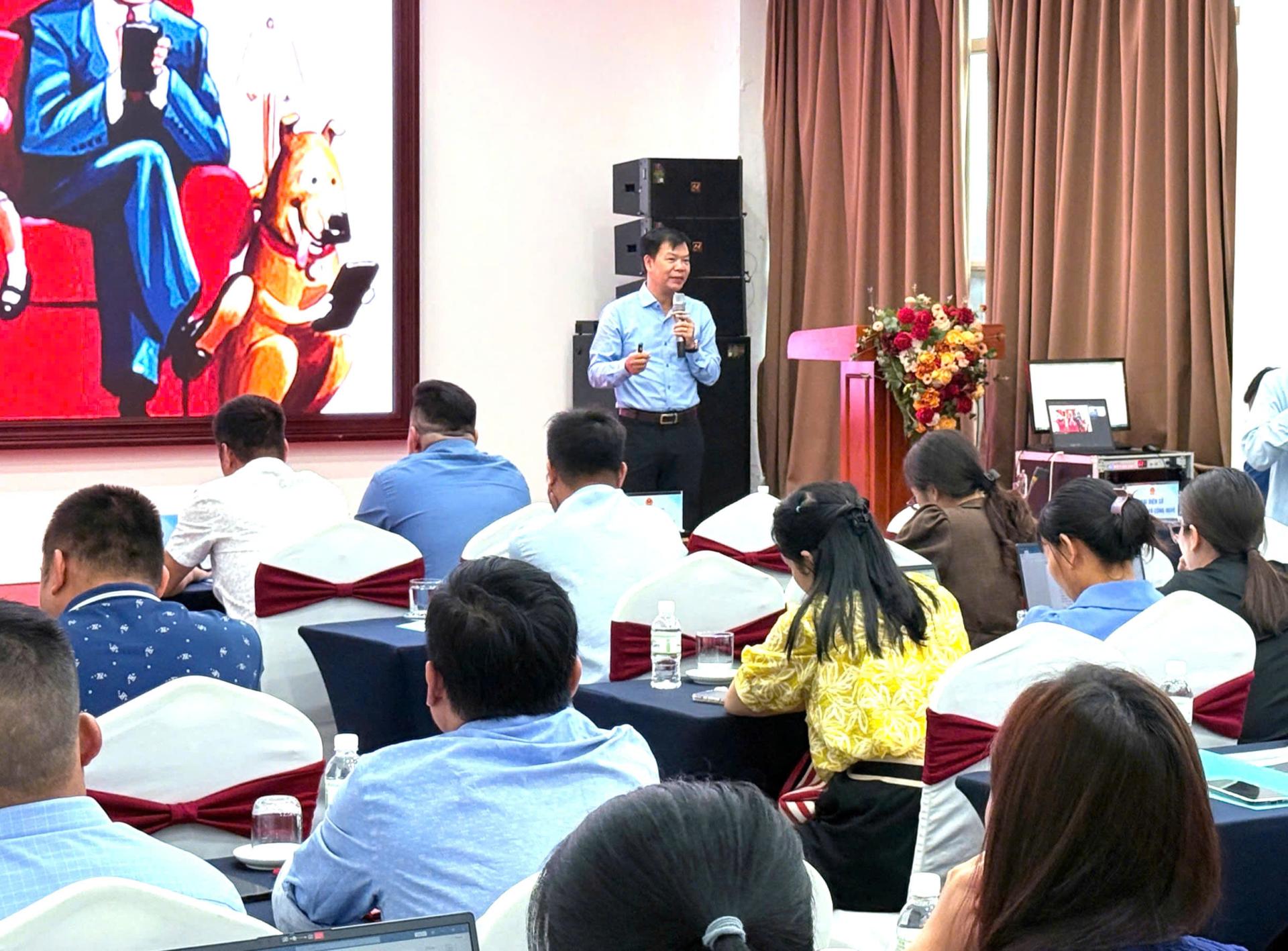
State management officials in Dien Bien are interested in learning about Criterion 7.3 on the effective implementation of e-commerce activities in the construction of new rural areas in the period 2026-2030.
Another important point shared by Mr. Tuan was the method of data collection and preparation of supporting documents. Instead of focusing solely on the final results, Mr. Tuan emphasized that localities need to develop a method of data collection that is well-founded, verifiable, and sustainable for long-term management. Therefore, at the conference, the Director of eComDX guided participants on data collection methods and the process of preparing supporting documents for evaluation, helping officials in Dien Bien to gradually identify information sources, methods of data aggregation, and data standardization techniques.
With this approach, the presentation by the Director of eComDX not only provides an additional set of evaluation criteria but also aims to establish a data-driven, accountability-based, and verifiable implementation process. According to Mr. Tuan, this is the foundation for communes and wards to proactively implement Criterion 7.3, while also providing management agencies with more practical data to monitor, evaluate, and plan e-commerce development solutions that are appropriate to the socio-economic characteristics of each locality.
With a focus on tangible results, eComDX will continue to work alongside localities to effectively implement Criterion 7.3, contributing to expanding markets for rural products, increasing people's income, promoting the development of the digital economy, and successfully implementing the National Target Program for New Rural Development in the 2026-2030 period.
Use AI in a methodical, controlled manner and tailored to specific requirements.
A notable highlight of the eComDX Director's presentation at the conference was the practical application of AI in the workplace. Instead of simply introducing tools, Mr. Tuan focused on the skill of building prompts so that AI can correctly understand requirements and produce appropriate results. He introduced the "SCIFE" framework, consisting of five components: Subject/Stakeholder, Context, Instruction, Format, and Examples/Style. This method can be directly applied when government officials in Dien Bien need to build reports, analyze situations, synthesize information, or prepare content for their professional duties.
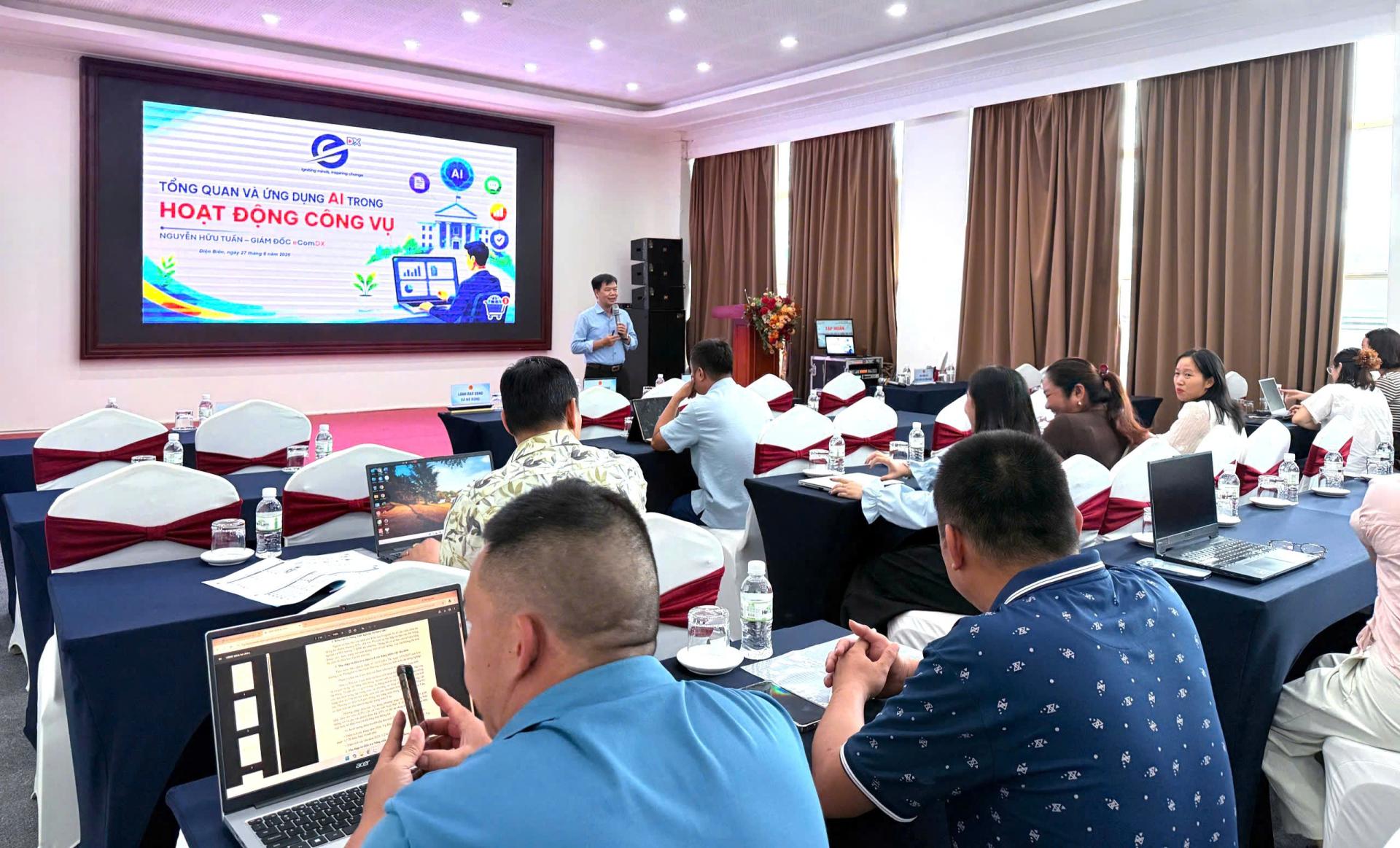
The training content was practical and received great interest from the trainees.
In addition, Mr. Tuan helped students access techniques such as Few-Shot Prompting, Prompt Chaining, Self-Ask/Flip the Script, Delimiter, and Iterative Refinement. Among these, the approach of "breaking down a complex task into multiple consecutive commands" helps users better control the AI's processing, instead of expecting a single command to solve the entire task from the start.
Therefore, Mr. Tuan emphasized the principle of "Don't expect perfect results on the first try," thereby placing users in an active role of evaluating, providing feedback, and adjusting the results generated by AI.
In a workshop on integrating AI into real-world work situations, Mr. Tuan guided state management officials, businesses, household businesses, and cooperatives in Dien Bien in summarizing socio-economic reports, proposing key tasks for district/commune-level People's Committees, creating images, videos, audio, music, and presentation slides. The ecosystem of tools Mr. Tuan introduced included ChatGPT, Gemini, Gemini Notebook, Veo, Kling, ElevenLabs, Vbee, CapCut, Canva, and Suno, demonstrating how AI can participate in various stages of the process of creating and processing public service products.
The practical relevance of the AI application workshop not only helps state management officials in Dien Bien access a new group of technologies, but more importantly, it fosters a mindset of using AI methodically, with control, and in line with the specific requirements of each job position. “ AI only truly creates value when placed in the right context, given clear tasks, and constantly monitored and evaluated by humans ,” emphasized the Director of eComDX.
According to the assessment of the leaders of the Dien Bien Provincial Department of Industry and Trade, the content selected for the training program closely followed the practical needs of Dien Bien, from updating policies and laws on e-commerce, implementing Criterion 7.3 to AI application skills in work. The presentations by experts from the Department of E-commerce and Digital Economy, which linked theory with real-world situations, helped trainees not only improve their awareness but also gain additional methods and tools to immediately apply to management, production, business, and online market development. This gradually contributes to the formation of practical digital capabilities, creating a foundation for businesses, cooperatives, households, and management agencies in Dien Bien to be more proactive in the digital transformation process.
Related articles: