On October 5th and 6th, 2026, the Department of Industry and Trade of Cao Bang province, in coordination with the Center for E-commerce Development (E-commerce Department, Ministry of Industry and Trade), organized three training conferences on managing and developing e-commerce, enhancing skills in applying digital transformation, AI, and e-commerce in business in 2026.
.jpeg)
The conference was attended by Ms. Dam Thu Lieu - Deputy Director of the Department of Industry and Trade of Cao Bang province; representing the E-commerce Department was Mr. Nguyen Huu Tuan - Director of the E-commerce Development Center (eComDX); along with more than 100 trainees including officials, civil servants, businesses, cooperatives, OCOP entities, and business households in Cao Bang province.
Strengthen coordination with management agencies to implement e-commerce development tasks in the area.
Over the years, e-commerce has gradually become an important method of business, distribution, and product promotion, contributing to market expansion, improved customer accessibility, and the acceleration of digital transformation in production and business operations.
In her opening remarks at the conference, Ms. Dam Thu Lieu, Deputy Director of the Department of Industry and Trade of Cao Bang province, emphasized that for Cao Bang province, e-commerce has practical significance in supporting businesses, cooperatives, and business households, especially those producing OCOP products, agricultural products, and local specialties, to gradually access wider markets, reduce dependence on traditional consumption methods, and enhance product value.
However, the rapid development of e-commerce also poses new demands on state management. Legal regulations on e-commerce are continuously being improved; business methods in the digital environment are becoming increasingly diverse; and new issues are emerging related to managing business activities, inspecting, detecting and handling violations, protecting consumer rights, and implementing e-commerce criteria in the context of building new rural areas.
In this context, the leaders of the Cao Bang Department of Industry and Trade believe that timely updating of legal regulations, exchanging experiences, and unifying the methods of task implementation among agencies, units, and localities are extremely necessary.
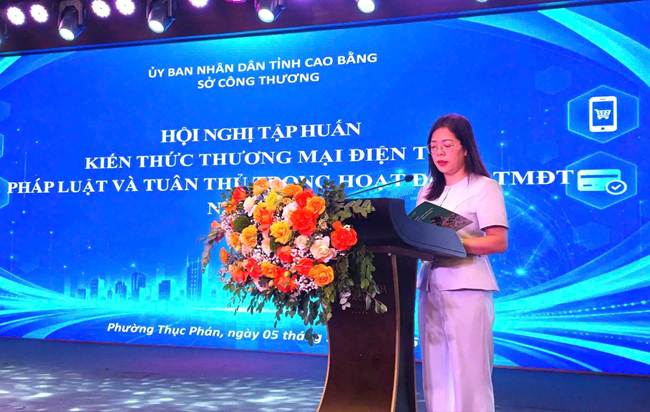
Ms. Dam Thu Lieu - Deputy Director of the Department of Industry and Trade of Cao Bang province
The leaders of the Department of Industry and Trade affirmed that the Department will continue to promote its role as the leading specialized agency, strengthening coordination with the E-commerce Department, other departments, agencies, and localities in implementing e-commerce development tasks in the province; at the same time, it will compile difficulties and obstacles beyond its authority to report and propose solutions to competent authorities for consideration and guidance.
At the conference, delegates were updated on the latest legal provisions regarding e-commerce; informed about the current state, models, and development trends of e-commerce in Vietnam; guided on some skills in inspecting, detecting, and handling administrative violations in e-commerce activities; and received guidance on criterion 7.3 in the National Criteria Set for New Rural Development in the field of e-commerce; updated on relevant regulations for sellers and KOC/KOLs in e-commerce; guided on the application of AI in content creation, image design, and short videos introducing agricultural products and OCOP; and guided on the practical application of AI and online sales skills…
.jpeg)
The participants were enthusiastic about the topics presented at the conference.
According to the Deputy Director, the conference is an opportunity for the Department of Industry and Trade and other agencies, units, and localities to directly exchange views with specialized agencies under the Ministry of Industry and Trade on difficulties and obstacles arising from practice, thereby contributing to improving the effectiveness of state management of e-commerce in Cao Bang province, aiming to narrow the gap and promote sustainable development.
The trend is shifting from "growth based on quantity" to "growth based on value and reputation".
At the training conference, eComDX Director Nguyen Huu Tuan emphasized that the e-commerce trend is shifting from "growth by volume" to "growth by value and reputation." According to Mr. Tuan, official brand stores (Mall stores) maintain their position; while the number of Mall stores accounts for less than 3% of the total number of stores, they represent nearly 35% of the total market revenue and are showing a strong upward trend. For the beauty industry, Mall stores increased by 10%, while non-Mall stores decreased by 8%. This shows that consumers are increasingly prioritizing products with clear origins, reputable brands, and high quality.
Notably, with strong growth in various product categories, Mr. Tuan stated that the General Merchandise - Food group increased by 151.1%, Women's Fashion by 74.8%, and Automobiles - Motorcycles by 56.3%, indicating significant potential for products with clear origins, quality, and brand recognition.
.jpeg)
Mr. Nguyen Huu Tuan - Director of eComDX
In terms of operations, according to experts from the E-commerce Department, the scale of postal services in Vietnam is experiencing "rapid growth," reaching over 3 billion parcels (orders), with a compound annual growth rate of 39% from 2018 to 2024. By 2025, the Vietnamese postal industry is expected to record approximately 4.1 billion parcels with revenue reaching around 87,000 billion VND, more than 12 times higher than in 2010, with last-mile orders in e-commerce accounting for a large proportion. However, assessing the current development trend, Mr. Tuan believes that the e-commerce market has shifted, "from a race to 'burn money on subsidies' to focusing on 'service quality'." Along with that, same-day delivery (under 24 hours) with comprehensive automation processes to optimize time and costs is becoming the new standard.
Regarding the "Vietnam E-commerce Trends 2026," Mr. Tuan introduced four key shifts: "Shoppertainment becoming the 'new standard'," combining shopping with short videos and livestreaming; "AI & hyper-personalization," where AI analyzes behavior, shopping history, and preferences to provide relevant content and products; "The rise of niche communities," with micro-influencers and KOCs possessing expertise and credibility within their small communities; and "Seamless multi-channel commerce," aiming to "blur the boundaries between online and offline." According to Mr. Tuan, these trends offer insights for businesses and households in Cao Bang to innovate their approach to customers, promote local specialties, and build a consistent shopping journey across multiple channels.
Criterion 7.3: Accurately measure the level of participation and effectiveness of e-commerce at the local level.
Introducing Criterion 7.3 at the Conference, the Director of eComDX stated that the Criterion is approached to measure the actual level of participation and effectiveness of e-commerce at the local level, rather than just looking at the number of activities organized. The criteria are structured into three groups: "Digital capabilities and skills," "Local community ecosystem," and "Level of e-commerce implementation."
Notably, Mr. Tuan stated that for businesses, cooperatives, household businesses, and individual business owners in Cao Bang, the "Digital Capabilities and Skills" group focuses on skills closely related to actual business operations, such as "Training in livestream sales, online sales, application of artificial intelligence (AI) in e-commerce, digital advertising, and cross-border sales."
Lecturers and students pose for a commemorative photo at the conference.
At the community level, the "Community E-commerce Ecosystem" model proposes 2-4 community e-commerce support groups, along with 1-2 exemplary business entities, 1-2 logistics and delivery units, and 1-2 live stream sales sessions. "This could be a platform for Cao Binh businesses to support each other, from product photography and digital store operations to promoting local specialties," Mr. Tuan shared.
During the discussion, Mr. Tuan suggested that localities would need strong involvement from provincial People's Committees and state management agencies such as the Department of Industry and Trade, the Department of Agriculture and Environment, and the local Tax and Statistics agencies. Synchronized direction would facilitate data sharing and implementation.
Practical principles to help KOCs/KOLs practice their profession transparently and responsibly.
Sharing some notes on online advertising and sales with businesses, cooperatives, and household businesses in Cao Bang, Mr. Tuan cited the situation of "KOL/KOC reviewing products while concealing sponsorship." According to Mr. Tuan, this is a typical example to help identify the responsibility of those conveying advertisements. In the situation, KOC B received 50 million VND from a functional food company to create a video claiming the product helped them lose 5kg in a month, but in reality, they did not use the product but were on a diet prescribed by a doctor. This example shows that dishonest product reviews, while concealing sponsorship, can lead to violations of advertising regulations and provide misleading information to consumers.
Based on this situation, Mr. Tuan noted that those conveying advertisements must actually use the goods when giving reviews and feedback; they must have documents and contracts to prove the content being advertised and must publicly disclose that it is an advertisement or sponsorship. Before filming, they need to attach identifying labels such as #Advertisement, #Collaboration, #PaidAd; submit documentation declaring product quality and retain evidence of product use. These are practical principles that help KOCs/KOLs practice transparently and responsibly, and protect consumer trust.
Enthusiastic practice of AI applications
Presenting at the Conference on Overview and Application of AI in Public Service, Mr. Tuan shared insights on the role, benefits, and development of artificial intelligence; trends and AI technologies impacting e-commerce; and AI applications that enhance work efficiency, optimize processes, and promote digital transformation in agencies, businesses, and households, etc.
.jpeg)
Participants practice at the conference.
To concretize the above content, the Director of eComDX connected the conference participants in a Zalo practice group to provide hands-on guidance, practicing AI applications for information retrieval and exploitation, searching and applying legal documents, building reports and thematic papers, composing official emails, designing slides, banners, audio and video... The focus of the practice session was on guiding the technical aspects of writing prompts, with a highlight being the SCIFE formula consisting of: "Role, Context, Instructions, Formatting, and Example". The practice exercises were specifically designed, with diverse topics closely related to the practical activities of civil servants, businesses, households, KOCs, etc., in Cao Binh.
To assess the effectiveness of students' practical projects, Mr. Tuan provides a checklist with detailed work items for verification. The checklist helps students thoroughly review everything from identifying the target audience and developing a strategy to creating content, producing, finalizing, and submitting their project.
.jpeg)
"Products" of practical work by trainees participating in the training course.
The enthusiastic interaction of the trainees during the Q&A session and the case study practice at the conference demonstrated the practicality of the training content and its positive response from a large number of participants.
At the end of the two-day training course, participants not only updated their knowledge and skills but also gained tools to immediately apply to their management, production, business, and product promotion activities. Participants expressed their enthusiasm for learning how to use AI to design images and videos to introduce their products, thereby confidently promoting them widely on digital platforms.
This also serves as a basis for strengthening coordination between state management agencies and the business community, gradually forming an e-commerce ecosystem suitable to local conditions, contributing to expanding markets, enhancing product value, and promoting digital transformation and the development of the digital economy in Cao Bang in a substantive, effective, and sustainable manner.